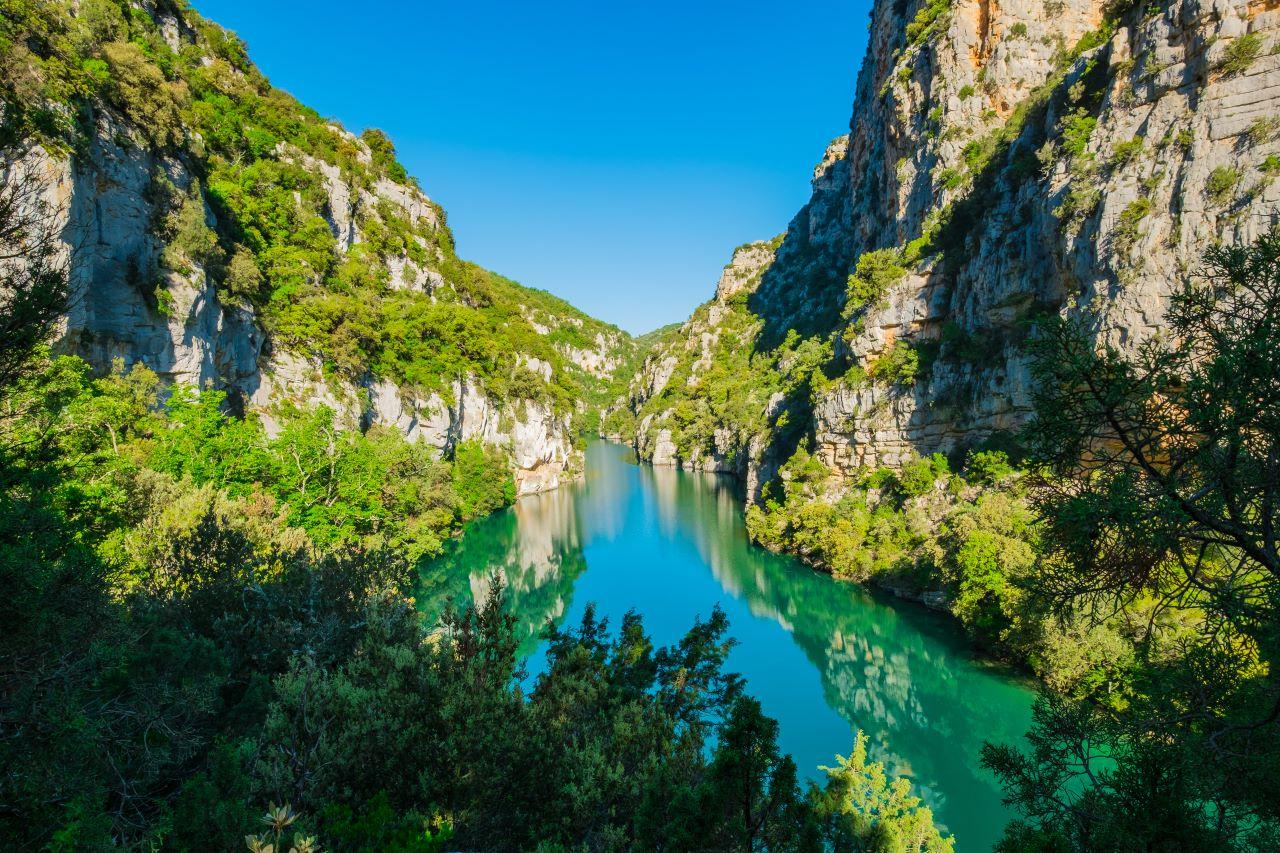
Provence · Alpes-de-Haute-Provence · The Grand Canyon of Europe
Gorges du Verdon
The Grand Canyon of Europe, in Provence — up to 700 m deep, with a turquoise river, the Route des Crêtes viewpoints, and the lake at Sainte-Croix. When to go and the best ways to experience the gorge.
5 Ways to Experience the Gorges du Verdon
Choose How You See the Canyon
The gorge is huge, the roads are winding, and the best of it is spread between clifftop viewpoints, the river and the lake. These are the five ways travelers actually experience the Verdon.
See the Canyon in One Big Day
Full-day guided tours loop the Route des Crêtes viewpoints, drop to the turquoise Lac de Sainte-Croix, and stop in clifftop Moustiers-Sainte-Marie. The easiest way to see the gorge without driving its hairpins yourself — departures from Nice, Aix and beyond.
Browse Day Trips →Onto the Turquoise Water
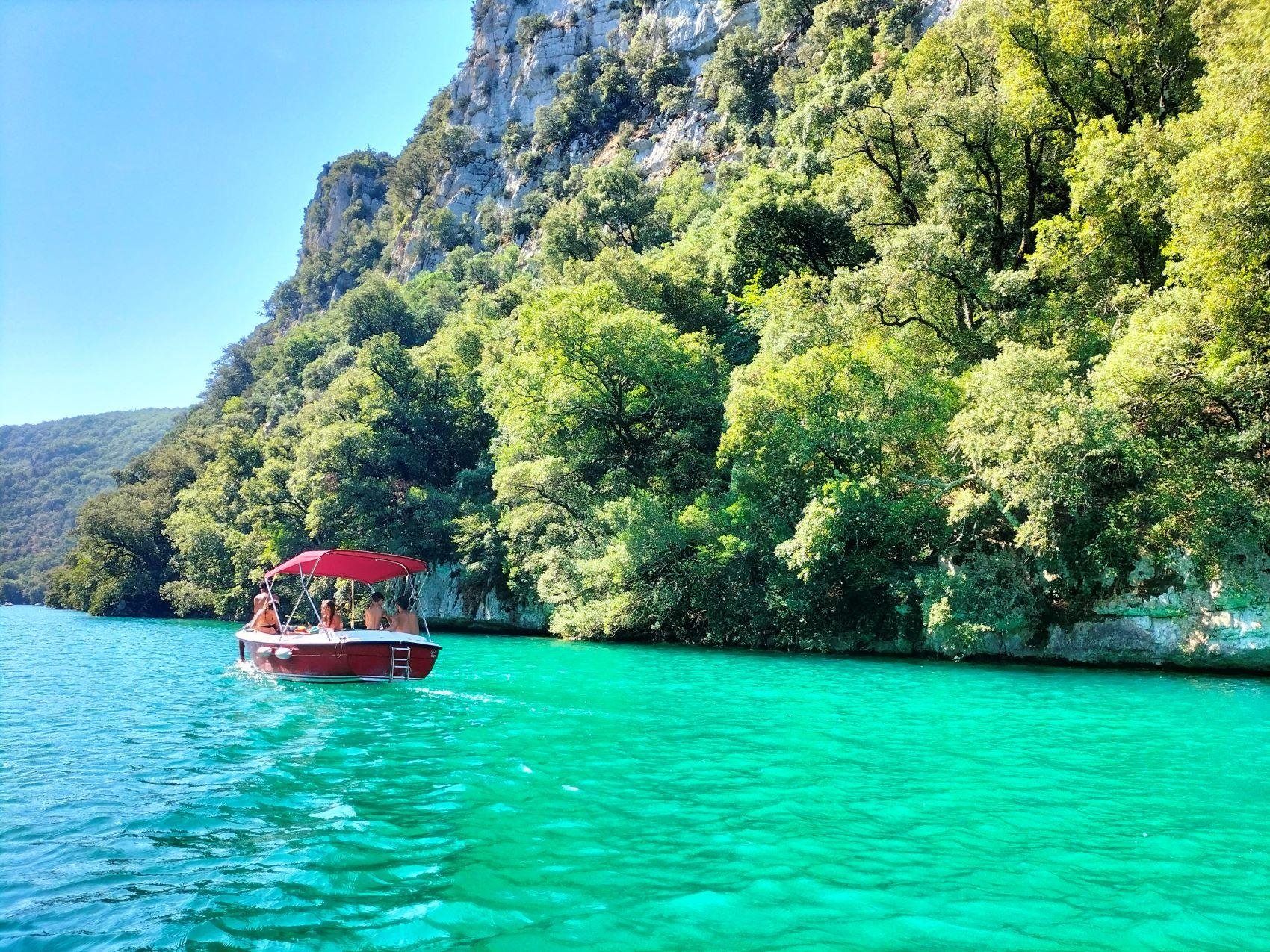
From the Pont du Galetas at the canyon's mouth, paddle a canoe, kayak or stand-up board up into the gorge, or hire an electric boat or pedalo on Lac de Sainte-Croix. The classic Verdon photo — and the cheapest way in.
Browse Boat & Kayak →Down the River Itself
Based in Castellane, the northern gateway, white-water rafting, aqua-trekking and canyoning take you into the river at the bottom of the canyon. Family-friendly floats through to athletic canoe-raft runs — the active way to feel the Verdon's scale.
Browse Rafting →Your Own Guide & Pace
Small-group and private tours adapt the route to you — more time at the viewpoints you want, fewer stops you don't, and a vehicle that handles the canyon roads. Best for photographers, couples and families who want flexibility.
Browse Private Tours →Pair the Gorge with the Lavender
The Valensole lavender plateau sits right beside the canyon, so summer combo tours add the purple fields to the gorge, the lake and Moustiers. The most scenery you can fit into a single Provence day, late June to mid-July.
Browse Combos →The Lay of the Land
What Makes the Gorges du Verdon Special
A quick orientation to the canyon, the river, the viewpoints and the lake before you choose a tour.
The Grand Canyon of Europe
The Verdon is one of Europe's deepest and most spectacular river canyons — up to about 700 metres deep and roughly 25 kilometres long, carved by the Verdon river through pale limestone. It earns its nickname, the "Grand Canyon of Europe."
Why the water is turquoise
The river's famous green-turquoise colour comes from very fine limestone particles — "rock flour" — suspended in the water, along with minerals and microscopic algae, which scatter the light. It is at its most vivid on a bright day.
The Route des Crêtes & Point Sublime
The Route des Crêtes is a partly one-way panoramic loop above La Palud-sur-Verdon, strung with belvedere viewpoints where griffon vultures circle. Point Sublime, near Rougon, looks straight down the Samson Corridor into the canyon's entrance.
Lac de Sainte-Croix at the mouth
Where the canyon opens out lies Lac de Sainte-Croix, a vast turquoise reservoir created by the Sainte-Croix dam in 1974 and one of France's largest. From the Pont du Galetas you can paddle straight back up into the gorge.
Planning Your Visit
When to Go & How to Get There
The Verdon is a seasonal, car-or-tour destination — a little planning makes the difference between a great day and a long drive.
- Best season is May to September. The water sports, boat hire and panoramic roads are all open and at their best; June and September give you the good weather with thinner crowds. July and August are busiest and hottest.
- There's no train to the gorge. Almost everyone arrives by car or on a guided tour. By road it's roughly 1h40–2h from Aix-en-Provence, and about 2–2.5 hours from Nice or Marseille — which is why day tours exist.
- Castellane is the northern gateway; Moustiers-Sainte-Marie the western one. Castellane is the base for rafting and canyoning; Moustiers — a "most beautiful village" famous for its faïence ceramics and the gold star strung between two cliffs — sits between the lavender and the lake.
- Want the lavender too? The Valensole plateau peaks roughly the last week of June through mid-July. If your dates line up, a combo day adds the purple fields to the gorge — see our dedicated lavender & Verdon Gorge combo page.
Where the Gorges du Verdon is
The Gorges du Verdon cuts through the Alpes-de-Haute-Provence, in the back-country of southeastern France between the Riviera and the lavender plateaus. The Verdon river has carved a limestone canyon up to roughly 700 metres deep and about 25 kilometres long — the reason it’s so often called the Grand Canyon of Europe. There is no railway to the gorge, so nearly every visitor arrives by car or on a guided day tour from Nice, Aix-en-Provence, Marseille or Castellane.
The three ways the canyon is usually seen
Most people experience the Verdon from one of three angles. From above, the clifftop belvederes — the Route des Crêtes loop above La Palud-sur-Verdon and Point Sublime near Rougon — give the vertigo-inducing panoramas. From the water, the turquoise Lac de Sainte-Croix at the canyon’s mouth is where canoes, kayaks, pedalos and electric boats set off up into the gorge from the Pont du Galetas. And from the river itself, rafting, aqua-trekking and canyoning out of Castellane put you in the cold green water at the bottom of the canyon.
Lac de Sainte-Croix and Moustiers-Sainte-Marie
At the western end the canyon opens into Lac de Sainte-Croix, a vast turquoise reservoir created by the Sainte-Croix dam in 1974 and one of the largest artificial lakes in France. On a shoulder above it sits Moustiers-Sainte-Marie, listed among les plus beaux villages de France, known for its faïence ceramics and the gold star suspended on a chain between two cliffs. The two together make the natural lunch-and-photo stop on almost every gorge day trip.
Pick your way in
The gorge is too big to do everything in one visit, so start with the experience you want: a full-day guided day trip that loops the viewpoints and the lake, a boat or kayak tour on Lac de Sainte-Croix, a rafting or canyoning adventure from Castellane, a private or small-group tour at your own pace, or — in high summer — a lavender and Verdon Gorge combo. Coming from the coast, see the dedicated day trips from Nice and from Aix-en-Provence.
Plan your visit — free Verdon guides
New to the canyon? Start with our in-depth planning guides:
- Gorges du Verdon viewpoints & the Route des Crêtes — the north- and south-rim drives, Point Sublime and Col d’Illoire.
- The best time to visit the Gorges du Verdon — month by month, when the roads open, and dodging the crowds.
- How to get to the Gorges du Verdon — drive times from Nice, Marseille and Aix, and why there’s no train.
- Lac de Sainte-Croix — swimming, electric boats and paddling up into the gorge from the Pont du Galetas.
- Moustiers-Sainte-Marie — the gold-star village, its faïence pottery and the chapel climb.
Gorges du Verdon — Frequently Asked Questions
Everything to know before you visit the Verdon Gorge in Provence.
The Gorges du Verdon is a limestone river canyon in Provence, southeastern France — up to about 700 metres deep and roughly 25 km long, carved by the turquoise Verdon river. It's widely known as the 'Grand Canyon of Europe' and is one of the continent's deepest and most spectacular gorges.
There is no train to the gorge and very limited bus service, so most car-free visitors come on a guided day tour from Nice, Aix-en-Provence, Marseille or Castellane. Tours handle the winding canyon roads, the viewpoints, the lake and the village stops for you.
May to September is the best window, when the roads, boat hire and water sports are all open. June and September give good weather with smaller crowds; July and August are busiest and hottest. To catch the Valensole lavender too, travel late June to mid-July.
Its vivid green-turquoise colour comes from very fine limestone particles ('rock flour') suspended in the water, together with minerals and microscopic algae that scatter the light. The colour is most striking on a bright, sunny day.
Lac de Sainte-Croix is a large turquoise reservoir at the mouth of the canyon, created by the Sainte-Croix dam in 1974 and one of the largest artificial lakes in France. From the Pont du Galetas you can rent canoes, kayaks, pedalos and electric boats to paddle up into the gorge.
The Route des Crêtes — a partly one-way panoramic loop above La Palud-sur-Verdon — has a string of clifftop belvederes where griffon vultures circle. Point Sublime, near Rougon, looks down the Samson Corridor into the canyon entrance and is the most famous single viewpoint.
By road it's about 1h40–2h from Aix-en-Provence (the closest major base), and roughly 2–2.5 hours from Nice or Marseille. Drive times vary with traffic and which part of the gorge you're heading to.
The main experiences are guided day trips that loop the viewpoints and villages, canoe/kayak and boat trips on Lac de Sainte-Croix, white-water rafting and canyoning from Castellane, and private or small-group tours. In summer, combo tours also add the Valensole lavender fields.
Yes — it's one of Europe's most dramatic natural landscapes, combining a vast canyon, a turquoise river, a swimmable lake and a 'most beautiful village' (Moustiers-Sainte-Marie) within a single day's loop. It's a highlight of inland Provence.
No. These are tours run by local operators and sold through GetYourGuide, with instant confirmation and free cancellation on most tours up to 24 hours before.
Still have questions? Email us at info@gorgesduverdon.tours
Ready to See the Gorges du Verdon?
Start with the most popular full-day trips that loop the viewpoints, the lake and Moustiers — or pick your own way in above.
Guided day trips · Free cancellation on most tours · Instant confirmation